What Happens on the First Loss of an AI Bot Martingale on Pocket Option with $500 Trades
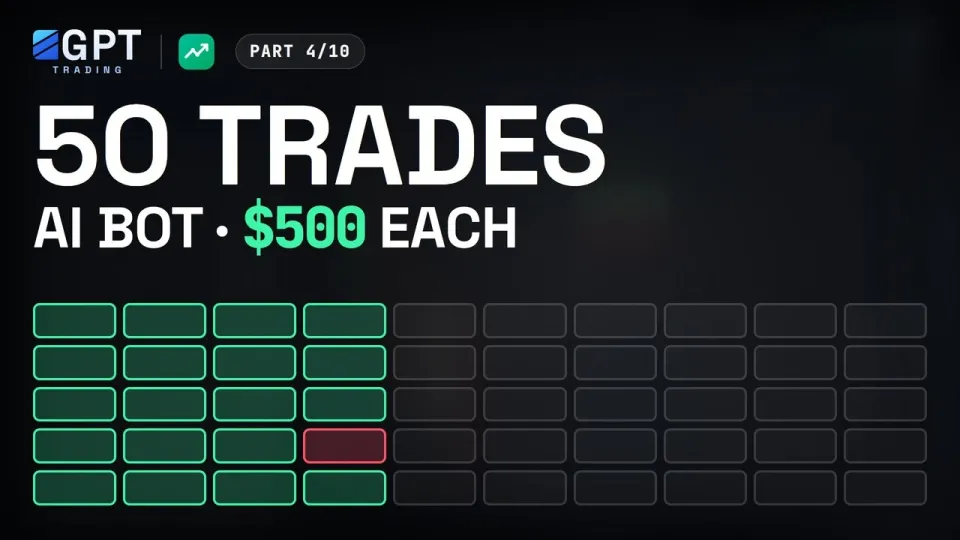
· based on the channel GPT Trading BOT | Pocket Option Auto Trading
Key takeaways
- Trade 19 was the first loss of the session: −$500 on a $500 base stake.
- Trade 20 used the one-step Martingale: stake raised to $1,100 and closed at +$1,012.
- Part 4 result: 4 wins, 1 loss, +$1,892 across trades 16–20.
- Balance moved from $45,175.44 to $47,067.44; the session so far is +$8,792.
- Session settings: Gold status, Performance mode, 30s–1M deal time, auto-selected pair, 50-trade limit.
The first loss of the session came on trade 19 and cost $500; the very next deal, trade 20, was the one-step Martingale at an $1,100 stake, which closed green at +$1,012. Across trades 16–20 the bot finished with 4 wins and 1 loss for +$1,892, lifting the balance from $45,175.44 to $47,067.44. The session runs on GPT Trading's Gold settings, and you can test the same setup through the free GPT Auto Trading access page.
What the first loss of an AI bot Martingale on Pocket Option actually looked like
The loss arrived as a single, ordinary red trade rather than a broken streak. Trade 19 was opened at the standard $500 amount used throughout the marathon and closed out of the money, removing exactly one base stake from the account. There was no manual override, no restart and no change of pair — the bot simply logged the loss and moved to the next entry.
What matters for anyone reading a martingale bot's equity curve is the sequence around that loss:
- Trade 19 closes red at −$500.
- The recovery step is armed automatically, because one-step Martingale is enabled in the settings.
- Trade 20 opens at $1,100 — the base stake plus the amount needed to recover the loss and still book a profit.
- Trade 20 closes green at +$1,012, which covers the $500 loss and adds a net gain.
- The stake resets to $500 for the following trade.
The arithmetic is the point. A $500 loss plus a $1,100 win at roughly a 92% payout produces about $1,012 in gross profit on the recovery trade, leaving a net of roughly $512 for the pair of trades. That is the entire logic of a one-step martingale: the losing trade is treated as a cost of doing business, not as a signal to stop.
Session settings behind trades 16 to 20
The marathon uses one fixed configuration for all 50 trades, so part 4 runs on exactly the same parameters as the earlier parts. Gold status is active, Performance mode is on, deal time is set to the 30s–1M range, the currency pair is auto-selected by the bot, and the trade amount is $500. One-step Martingale is enabled, and the session carries a 50-trade limit so the bot stops on its own when the marathon ends.
Gold activates automatically once a Pocket Option balance is above $300, which unlocks automated risk management and Performance mode. On Gold there are no deal limits, everything syncs in the cloud rather than being configured in the terminal, and the bot cannot place a trade without the user's permission. The workflow is: choose trade mode, deal time, currency pair and amount, then tap Start Auto Session and let the software open deals on the linked Pocket Option account.
Why one step of Martingale changes the risk profile
A single recovery step multiplies exposure on the trade immediately after a loss, and that is the whole difference between this configuration and a flat-stake bot. With a $500 base, one loss plus one recovery step puts $1,600 of turnover on two consecutive trades, and the second of those carries more than double the risk of the first. If trade 20 had lost as well, the drawdown would have been $1,600 rather than $500, because a one-step martingale has no second recovery level to fall back on — the sequence resets after the step, win or lose.
That design is deliberately capped. A classic martingale doubles repeatedly (500, 1,000, 2,000, 4,000 and so on) and can exhaust an account after a handful of consecutive losses. A one-step version limits the escalation to a single trade, which keeps the worst-case sequence bounded but also means a second consecutive loss is absorbed at the base stake rather than recovered. In this session the cap was never tested: trade 20 won, and the stake returned to $500.
Part 4 result and running balance
The five trades in this segment closed between 18:20 and 18:25 and produced 4 wins and 1 loss for a net of +$1,892. The account moved from $45,175.44 at the start of the part to $47,067.44 at the end, and the session total after 20 trades stands at +$8,792. The loss on trade 19 is fully embedded in those numbers — the segment is profitable despite it, not because it was avoided.
Reading the part in isolation is misleading, which is why the marathon is split into ten parts of five trades each. A single five-trade window can look calm or violent depending on where the losses fall, and the first red trade of a session is the moment when a martingale configuration either proves its recovery step or exposes its cost. Here it did the former within about ten seconds of the loss.
Links from the video
- Free GPT Auto Trading access and promocode GPT100: https://gpt-trading.app/landing/go?vid_6VBsYhlTI6Y
- GPT Trading Club (reviews and news): https://t.me/gpt_trading_club
- Official website: https://gpt-trading.io
- Full playlist of the 50-trade marathon: https://www.youtube.com/playlist?list=PLD-wibqLCCes
What the first loss teaches about running a martingale bot
The first loss of a session is the clearest test of whether a martingale setting matches the account behind it. A $500 base stake with a one-step recovery requires at least $1,600 of available balance to survive a single loss-and-recovery cycle, and considerably more to absorb a losing recovery step without touching the rest of the account. On a $47,000 balance that is comfortable; on a $500 account the same settings would be unworkable.
The recorded part also shows the timing: the loss and its recovery happened within roughly a minute of each other, with no pause for manual input. That speed is the appeal of auto trading on Pocket Option and also its main hazard, because a losing streak is executed just as quickly as a winning one. Trade 19 and trade 20 are a useful pair to study before enabling one-step Martingale on any account size.
The full 50-trade, $500-per-trade breakdown is published by the channel GPT Trading BOT | Pocket Option Auto Trading, with part 4 covering trades 16–20. To run the same Gold configuration yourself, start from the GPT Auto Trading registration and free trial page and keep the risk warning in mind: results shown come from one recorded session and do not guarantee future performance.
Source: The First Loss: AI Bot Martingale on Pocket Option ($500 Trades) | Part 4/10 · Markdown version
Questions & answers
How much did the first loss cost in part 4 of the marathon?
Trade 19 closed out of the money at the standard $500 stake, so the loss was exactly $500. It was the only red trade among trades 16–20, which otherwise produced four wins.
How does the one-step Martingale recover a $500 loss?
After trade 19 lost, the bot opened trade 20 at $1,100 — the base stake plus the recovery amount. That trade closed at +$1,012, covering the $500 loss and leaving a net gain of roughly $512 for the pair before the stake reset to $500.
What were the settings used for this Pocket Option session?
Gold status with Performance mode, deal time of 30s–1M, auto-selected currency pair, $500 trade amount, one-step Martingale and a 50-trade session limit. Gold unlocks automatically once the balance exceeds $300.
What was the balance after trades 16 to 20?
The account went from $45,175.44 to $47,067.44, a gain of $1,892 for the part. After 20 trades the session total stood at +$8,792.