Meme coin trading can turn small stakes into six figures if you treat it as risk management rather than lottery
Want articles like this for your own video to promote it on YouTube and Google? Order them through the Telegram bot @sat_sit_bot. It writes articles around your video, embeds the video and publishes them on popular niche websites (no ads). Try it free: 50 articles on us.
· based on the channel Orangie Web3
Key takeaways
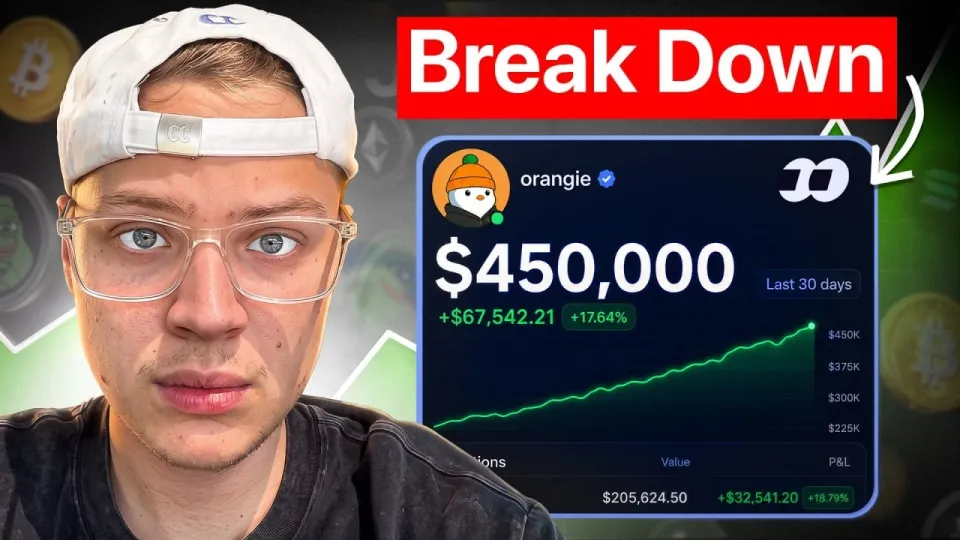
- The $450,000 in 30 days figure comes from a single trader's recorded run, not an average or a repeatable baseline.
- Memecoin P&L is driven by supply control, liquidity depth and exit speed more than by the meme itself.
- Most retail attempts end in a near-total loss on the first positions; one winner is expected to pay for many losers.
- Solana and launchpad-style platforms dominate the current memecoin cycle because issuance is cheap and fast.
- Copy-trading groups and insider calls create an edge that a solo beginner cannot replicate by watching videos alone.
Meme coin trading is the practice of buying tokens with no cash flow, no product and no valuation model, purely on the expectation that another buyer will pay more later. The $450,000 in 30 days result shown by Orangie Web3 is real as a personal outcome but it is not a return you can plan for: it came from a small number of outsized winners inside a high-volume, high-risk strategy. Anyone starting out should treat the Kaizen group access as a learning and community resource, not as a guarantee of profit.
What a meme coin actually is and why it moves so fast
A meme coin is a token whose value rests entirely on attention, culture and liquidity, which is why its price can multiply in hours and collapse in minutes. There is no earnings report to anchor a valuation, so the only inputs that matter are how many tokens exist, who holds them, how deep the trading pool is and how many new buyers arrive per hour.
That structure produces the characteristic pattern of the niche:
- A token launches with a large supply, often in the billions or trillions, priced at fractions of a cent.
- Early wallets, sometimes the deployer's own, hold a large share of that supply.
- A narrative — a dog, a frog, a character, a slogan — spreads through social feeds and group chats.
- Volume spikes, the price chart goes vertical, and late buyers provide the exit liquidity for early ones.
- Most tokens die within days; a tiny minority hold value long enough to be listed on larger venues.
The $450,000 run described in the video is best understood as several of those minority cases hit in sequence, with position sizing large enough to matter and exits executed before the reversal.
The mechanics that decide whether you make money
Profit in this niche comes from three variables you can actually control: entry price relative to supply, position size relative to your bankroll, and exit discipline. Everything else — the mascot, the ticker, the Telegram hype — is noise that other traders use to move your behaviour.
- Supply and market cap. A token trading at $0.000004 with a one-trillion supply has a $4 million market cap, not a cheap price. Always convert price into market cap before judging whether there is room left.
- Liquidity depth. A $200,000 pool cannot absorb a $50,000 sell without crushing the price. Check the pool size before sizing a position, because your exit is capped by the liquidity you entered into.
- Holder concentration. If the top ten wallets hold most of the supply, the chart belongs to them, not to you.
- Sniping and bundling. Automated bots buy in the first block of a launch, which means the entry price you see on a chart is often already the post-snipe price.
How the traders behind large memecoin gains actually operate
Large results in this market usually come from information and execution advantages rather than from chart reading. Traders who post six-figure runs typically sit in private groups where calls are shared before they reach public feeds, run multiple wallets to test entries, and use tools that submit transactions faster than a manual click.
A realistic workflow for someone building skill looks like this:
- Track a small watchlist of launches instead of chasing every ticker that trends.
- Enter with a fixed, small amount per position — an amount you can lose entirely without changing your life.
- Set a plan before buying: a target where you take the initial capital out, and a level where you accept the loss.
- Scale out in tranches rather than selling everything at one price, because the top is only visible afterwards.
- Log every trade with entry market cap, exit market cap and the reason for the decision, so patterns become visible over dozens of trades.
The uncomfortable part, confirmed by traders who comment on these videos, is the loss rate: a beginner can lose most of a first deposit and still recover everything with one good position. That is the actual shape of the distribution, and it is why sizing matters more than conviction.
Common questions and doubts from new traders
Newcomers usually ask the same handful of things, and the answers are structural rather than motivational. The first is speed: explanations of entries, exits and coin selection are the most requested format, because the reasoning behind a trade teaches more than the outcome. The second is starting capital — many begin with a few hundred dollars, lose most of it while learning the interface, and only then develop a process.
The third recurring doubt is whether the results shown are achievable solo. They are achievable, but the edge is uneven: access to early calls, faster execution and the discipline to cut losers separate the profitable minority from the rest. Watching a walkthrough of someone else's trades is useful for understanding mechanics and vocabulary; it does not transfer their information flow. Treat any paid community, including the one linked in the video, as education and networking, and keep your risk capital separate from money you need.
Risk rules that keep a memecoin account alive
Survival in this market is a risk-management problem, not a prediction problem. Because a large share of tokens go to near zero, the goal is to stay in the game long enough for a winner to land.
- Cap any single position at a small percentage of your total trading bankroll, and assume it can go to zero.
- Never add to a losing memecoin position; averaging down on a token with no fundamentals is how accounts die.
- Take the initial capital out early on a runner, then let the remainder ride.
- Check contract permissions and holder distribution before buying, and avoid tokens where the deployer can mint or freeze.
- Expect slippage and fees on every trade; on small positions these can exceed the profit.
Useful links
- Kaizen group access: https://whop.com/checkout/plan_GTFkEFh0JFpU8?a=orangie
- FOMO trading platform: https://fomo.family/r/orangie
- Discord community: https://discord.gg/memecoins
- Instagram: https://www.instagram.com/orangieyt/
Final takeaway
The $450,000 in 30 days headline is a real trading outcome, but it is a distribution of a few large winners, not a salary. What transfers from that run is the process: small fixed bets, fast exits, attention to liquidity and supply, and a tolerance for many losses before one position pays. Orangie Web3 built the breakdown around that process, and the Kaizen group is where the community side of it lives. Start with money you can lose, log every trade, and judge yourself on process rather than on a single month's number.
Source: How I Made $450,000 Trading Memecoins in 30 Days · Markdown version
Questions & answers
How much money do you need to start trading meme coins?
You can start with a few hundred dollars, but the amount matters less than the sizing rule: no single position should be large enough to end your account if it goes to zero. Fees and slippage eat a bigger share of small positions, so beginners should expect the first phase to be tuition rather than income.
Why do most meme coin traders lose money?
Because supply is concentrated in early wallets and liquidity is thin, late buyers effectively fund the exits of early ones. Add sniping bots that buy in the first block and the average retail entry is already worse than the price shown on the chart. Losses on most positions are the norm, and one large winner is expected to cover them.
Is it realistic to make six figures in a month from memecoins?
It happens, as the $450,000 run shows, but it comes from a handful of outsized winners combined with large position sizes and fast execution. Repeating it month after month is not a realistic plan, and anyone presenting it as a steady return is omitting the losing streaks that precede such results.
What should I check before buying a new memecoin?
Convert the price into market cap, look at the size of the liquidity pool, and review how much supply the top wallets hold. Then check whether the contract allows the deployer to mint or freeze tokens. If the pool is small or a few wallets control the supply, your exit is in someone else's hands.